
- 50%
Treatment Suggestions Base on Case Type
Decision Tree
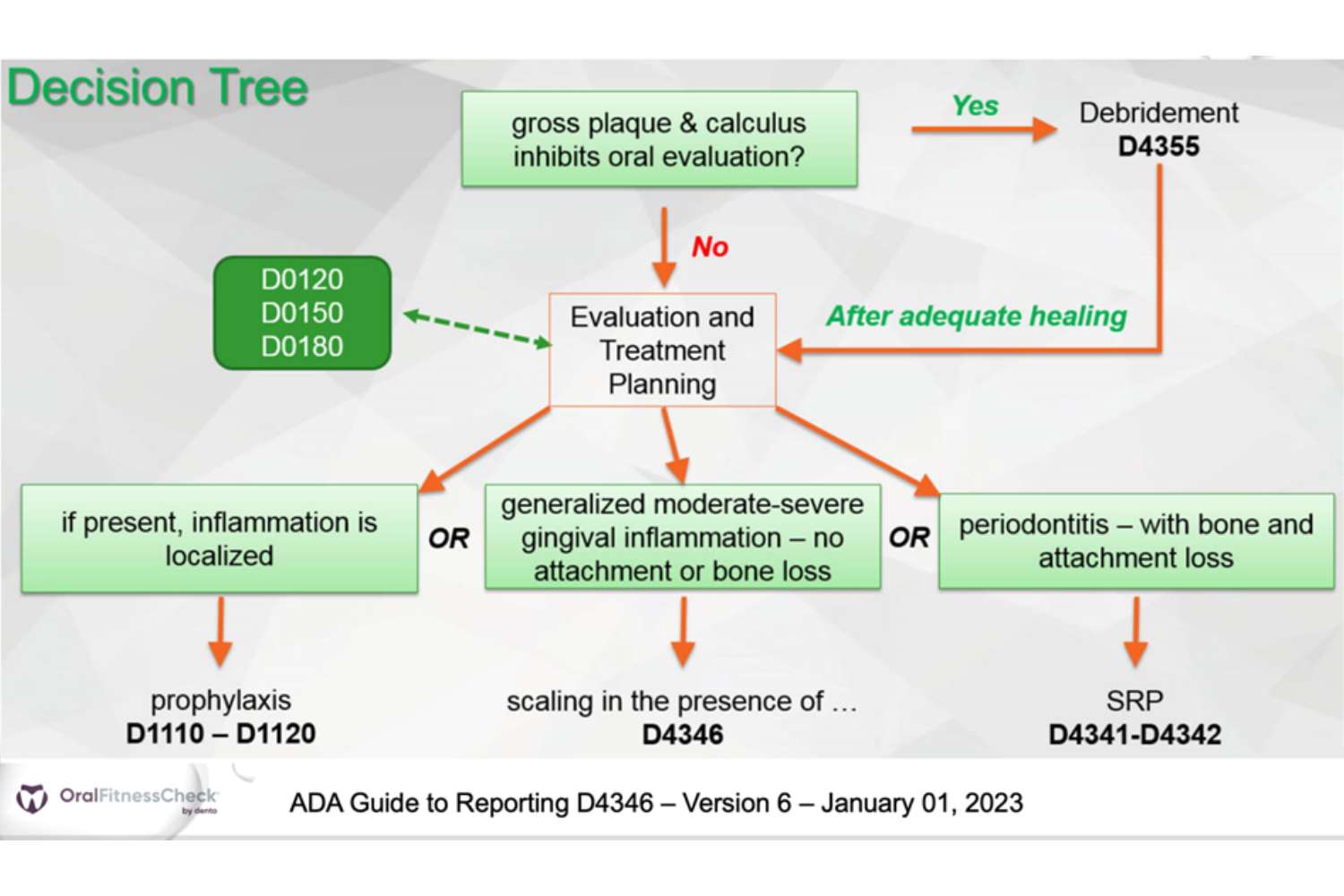
Case Type 1: New Patient
New Patient Exam with General Dentist or RDH (New, Limited Exam, etc.) with ELEVATED Oral Fitness Score
The patient needs additional care. If the patient had a Limited Exam, address the immediate concern and have the patient return for a Comprehensive Exam, including a Periodontal Assessment.
Or refer to the RDH for a Periodontal Evaluation to determine the need and subsequent treatment.
Case Type 2: Hygiene Recare Patient
Regular Hygiene Patient in Prophy Recare w/no pockets of 4mm or more (no bleeding, 6-month recare frequency) with an ELEVATED Oral Fitness Score
The patient may look fine, but periodontal tissue breakdown is actively occurring. Additional care is needed:
-
-
- Perform Prophylaxis CPT Code: D1110 or D1120.
- Review Oral Hygiene. Give specific instructions for Oral Hygiene, including frequency, hygiene aids, etc.
- Ask the patient when they last had a physical and bloodwork.
- Schedule the next visit for a 6-month recare. If there is no improvement in the Oral Fitness Score, perform a periodontal assessment to assess if more/new breakdown has occurred, and then go to the next step.
- Recommend increasing the frequency of hygiene recare visits to every 3-4 months.
Clinical Note: The doctor must decide during the 2-n-1 transfer. - Test at the next visit in 3-4 months to determine if recare frequency is sufficient.
-
Case Type 3: Hygiene Patient w/Gingivitis
Hygiene Patient w/ or without pockets (no radiographic bone loss) w/gingivitis (30% or more of mouth must exhibit bleeding) with an ELEVATED Oral Fitness Score
Due to their gingivitis, additional care is needed, which may include:
-
-
- Perform Gingivitis Scaling (CPT CODE: D4346 scaling in the presence of generalized moderate or severe gingival inflammation – full mouth, after oral evaluation.
- Provide full-mouth LASER Therapy—Tell the patient, “I will clean what I can with scaling, but I cannot physically remove all of the debris, so the LASER will kill the bacteria and stimulate healing.”
Clinical Note: Perform full-mouth LASER Therapy at this appt, but the coding is by quadrant. - Review Oral Hygiene and schedule the next visit in 6 months.
Clinical Note: Periodontal probing is not advisable at the 6-month follow-up since the tissue is healing and in a state of re-epithelialization. - If the Oral Fitness Score is elevated at the next visit and there is still bleeding, it is suggested to stop the prophylaxis and probe. Tell the patient, “We were hopeful you would respond favorably to the treatment we did 6 months ago. However, we need to go in a different direction based on your clinical situation and elevated Oral Fitness Score.”
- If they are improving, their Oral Fitness Score is lower, and there is less bleeding, but they need improvement in oral hygiene, it is recommended to increase the recare frequency.
-
Case Type 4: Periodontal Maintenance Patient
Periodontal Maintenance Patient (3-4 month recare) with ELEVATED Oral Fitness Score
-
-
- Perform Periodontal Maintenance, CPT Code: 4910.
- Review Oral Hygiene. Give specific instructions for Oral Hygiene, including frequency, hygiene aids, etc.
- Ask the patient when they last had a physical and bloodwork.
- Continue the treatment plan if responding favorably to dental treatment and the Oral Fitness Score is lowered at the next visit.
- If the patient does not respond favorably to dental treatment or if more breakdown occurs, refer to a periodontist and physician.
-
Clinical Note: Only recommend SRP if there is subgingival calculus and bleeding with an Elevated Oral Fitness Score—Use CPT CODE 4342. If localized to 1-3 teeth per arch, use CPT Code 4341—Suggest adding LASER treatment and optional locally delivered antimicrobial (Arestin).
Clinical Note: Recommend Custom Periodontal Trays with PerioGelX Oral Debriding Agent/Oral Wound Cleaner (Hydrogen Peroxide) in the maintenance phase ONLY if their home care is adequate.